








I graduated from Abu Dhabi University with a Bachelor of Architecture and a GPA of 3.98 – top of my class. During the winter semester of my senior year, I interned with GHD Engineering. The company was so pleased with my work that they extended the internship until the end of my senior year. After graduation, I was selected for Gensler's six-month Professional Internship Program. Gensler - ranked the top architecture firm globally at that time - was impressed with the quality of my portfolio and my design program capabilities. Had the global pandemic not resulted in a hiring freeze, I would have secured a full-time position with Gensler.
Following this, I decided to pursue a postgraduate program and chose the Master of Construction Management at the University of Kansas, USA, out of multiple offers from UK and USA universities. I am on course to graduate this year (May 2023) with a GPA of 4.0. and the options for my next step are wide open. GLMV Architecture in Kansas City extended my summer internship and offered me a full-time position after graduation. Or I might accept an offer from Kansas State University to study for a Ph.D. in Environmental Design. Abu Dhabi University gave me the skills to succeed in my field, and I am grateful to all the professors and teaching assistants who supported me through my undergraduate and postgraduate journey. I am excited to see what the future holds.
My journey at Abu Dhabi University has been nothing short of incredible, and it has played a huge role in shaping who I am today. As a graduate with honors from the Bachelor's program in Mass Communication in 2016, I had the privilege of being a student of some of the most knowledgeable and experienced educators in the field.
The program provided me with a solid foundation in communication theory, and I learned about various forms of media such as print, broadcast, and digital media. This allowed me to pursue my passion for content creation and media, and I was able to start my career as a content creator and presenter.
In 2019, I graduated with a Master's degree in Business Administration with a fellowship from Griffith University, Australia. I owe this achievement to the exceptional education I received at Abu Dhabi University.
ADU gave me a platform to develop my skills and knowledge beyond the classroom. As a member of the Media Youth Council, I had the opportunity to work with some of the brightest minds in the media industry, and we developed solutions for various media-related issues in the UAE.
Today, as a content creator and presenter, I owe much of my success to the education, mentorship, and opportunities provided by Abu Dhabi University. I am grateful to the faculty, staff, and fellow students who have supported me throughout my journey.
I was privileged to be taught by an outstanding faculty, providing incredible teaching efforts and support. Without this continuous support and world-class teaching, I wouldn’t have been able to accomplish the achievements I’ve always dreamed of. I was able to complete my bachelor's degree in mechanical engineering in three years due to the flexibility and availability of courses, which allowed me to graduate among the first cohort of students in 2014.
The resources available at ADU provided me with the opportunity to explore modern challenges in the field of conditioning monitoring and opened doors to new challenges. I also worked as a teaching assistant while pursuing my master's degree in mechanical engineering.
Thanks to ADU, I had the opportunity to broaden my academic horizons and learn from some of the best minds in the field. I am currently working as a doctoral researcher on the topic "AI-based condition monitoring of electro-hydraulic systems" at Tampere University, Finland.
"I aimed to make a positive impact on ADU during my time here."
"Having worked in different sectors for several years, I realized that law was my true passion. After conducting extensive research to find the best institution to pursue a bachelor’s degree in law, I found Abu Dhabi University to be impressive with its accreditations and world rankings."
"I am receiving the highest standards of education in my program, with excellent facilities and incredibly knowledgeable and supportive professors. The co-curricular activities at ADU have provided me with opportunities to participate in seminars and conferences, enabling me to apply what I have learned in real-world situations on an ongoing basis."
As an alumna of Abu Dhabi University's Bachelor of Arts in Mass Communication (English) program, I can confidently say that it provided me with the opportunity to learn the best practices in media production for various media platforms. Working with sophisticated equipment such as high-end cameras, lighting, vision mixers, and the audio console in the TV studio was an experience that gave me the confidence to work at both front and back camera in television production. The program helped me discover my true potential and transformed me into someone always ready to accept challenges. My parents were my motivation to succeed; my friends gave me the necessary support; my teachers provided the tools.
Set your goals and make a plan to achieve them!
As a current Bachelor of Science in Civil Engineering student at ADU, I can confidently say that the university has provided me with countless opportunities for growth and learning, both academically and personally. The faculty and professors have always been dedicated to ensuring that students receive a quality education, as well as inspiring us to push ourselves to new heights.
The supportive community at ADU has helped me to achieve my goals and aspirations, and I am grateful for the guidance and encouragement I have received from everyone involved. Although I will eventually graduate and move on to new endeavors, I know that the experiences and knowledge I have gained at ADU will stay with me throughout my life.
In short, ADU has had a profound impact on my academic journey and personal development, and I am proud to be a part of this exceptional institution.
ADU was one of the most significant stations in my journey. It provided me with ample opportunities to invest my time and energy in various extracurricular activities such as research, competitions, sports, and volunteering. I used to enjoy spending my time on campus using the available facilities. I am immensely grateful for the professors who acted as mentors and provided me with their knowledge and support, helping me identify my goals and achieve them in my career path. As a graduate in Business Administration, I am delighted that my BBA degree is double accredited by AACSB and EQUIS, which is a distinction only 1% of business schools worldwide have achieved.
The professors at ADU encourage you to succeed by nurturing your enthusiasm as well as improving your knowledge in the areas of biology, medicine, and engineering. Their doors are always open, and they deliver the classes in such an enjoyable way.
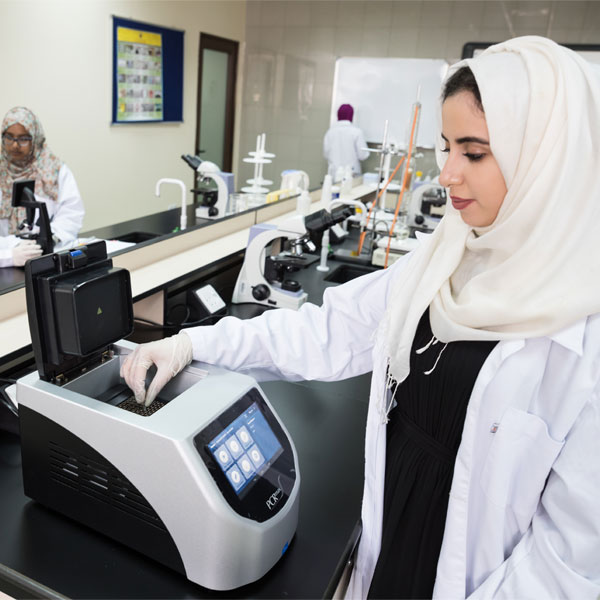
I have really enjoyed my biomedical courses and learned a lot, including about medical devices and how to design and classify them. Because of this, I feel I will be able to make a real difference in the biomedical engineering field and the health industry in general.
State-of-the-art technology is used in all the labs, providing students with an optimum hands-on learning experience. In fact, the Bioimaging Research Lab is affiliated with the University of Louisville's Bioimaging Lab, making it one-of-a-kind in the UAE.
“Prevention is better than cure!”
"I'm currently working in health education focusing on giving lifestyle advice to people with type 2 diabetes. As part of my program, I took an internship with the Department of Health and this experience helped me secure this position with Daman shortly after graduation.
ADU has given me so many opportunities. With the encouragement of my professors, I started the Public Health Club and held the position of Club President for a year. Through the Club, we attended numerous events and conferences related to our field, gaining a lot of practical experience along the way.
I've experienced several proud moments during my time at ADU including being honored in the Dean's List for my high GPA. My high point, however, was being appointed as a UAE Public Health Ambassador through the Health Authority Abu Dhabi's (HAAD) Public Health Ambassador Program. This aims to engage communities in healthy life choices which is, I believe, my vocation in life."
Dr. Hany Dowidar provides an overview of Abu Dhabi University College of Law’s mission, academic structure, and administration, before going on to discuss current challenges and opportunities in providing an Arabic-language legal education.
Established in 2017, Abu Dhabi University (ADU) College of Law currently offers one bachelor’s degree (Bachelor of Law) and two master’s degrees (Master in Public Law and Master in Private Law) taught primarily in Arabic. The undergraduate degree is offered in two ADU’s campuses, Abu Dhabi and Al Ain. In addition to these two campuses, the Master programs are likewise offered in the Dubai Campus.
2 - Vision & Mission
The ADU College of Law’s vision is to become the top law school in the UAE and among the top five law schools in the MENA Region, aiming to reach a size of 1,250 students by 2024. The College of Law’s mission is to provide specialized, internationally competitive, advanced legal education through innovative teaching and a forward-thinking approach at the forefront of legal education. My colleagues and I are proud of the high quality degree programs upon which we have built ADU’s young but fast-growing College of Law. We believe that law students should be provided with a specialized yet internationally competitive quality education and training. The ADU College of Law seeks to provide advanced legal education using modern technology and comparative approaches to help boost students’ abilities for the legal job market.
3 - Objectives
In light of its vision and mission, the ADU College of Law has the following objectives: a) Define programs and teaching methods that reflect the circumstances of Emirati society in particular and Arab society in general in order to serve the region’s needs and aspirations and prepare students for the requirements and challenges of the job market. b) Adhere to international accreditation and quality assurance regulations and criteria that guarantee consistency in the College of Law’s performance and the students’ right to obtain an internationally recognized degree that allows them to join the varied and competitive job market. c) Develop programs and courses to be delivered in English language so as to meet the requirements of the job market, as the legal profession in various functions and in an international setting require English. d) Ensure that students acquire critical thinking skills, knowledge and legal skills by varying teaching methods and approaches so as to include theoretical classes and practical training on legal issues in the form of workshops, seminars, debates, moot courts and arbitration, and legal clinic. All academic and training programmes in the College of Law’s pipeline are submitted to the College Advisory Board so as to ensure their relevance in the legal market. To keep up to date with market needs, Abu Dhabi College of Law has established a College Advisory Board comprising brilliant representatives from the Ministry of Justice, the Ministry of Foreign Affairs, law firms, and attorney associations. All academic and training programmes in the College of Law’s pipeline are submitted to the College Advisory Board so as to ensure their relevance in the legal market. In addition, College Advisory Board members offer law students opportunities for external internships that teach the practical aspects of legal knowledge.
4 - Values
The objectives of the College of Law can only be achieved within the framework of fundamental values of ADU College of Law. In parallel with ADU’s values of excellence, innovation, teamwork, and integrity— to which the College of Law fully adheres—the College of Law has the following values: • Loyalty: meaning honesty and keeping pledges. • Accuracy: meaning avoiding personal biases and interests. • Cultural Diversity: emphasizing respect for the “other” in case of differences. • Equality: meaning treating stakeholders of the same status on equal footing.
With regards to academics, and similar to other law schools in a civil law country, Abu Dhabi University College of Law has two distinct majors: (a) Public Law, which includes the following specific disciplines: 1. Public Law (Constitutional Law & Administrative Law). 2. Penal Law. 3. Public International Law. 4. Financial Law (economics, public finance, and tax legislation). (b) Private Law, which includes the following specific disciplines: 1. Islamic Law. 2. Civil Law. 3. Commercial Law (Commercial, Maritime & Air Law) 4. Civil Procedures Law. 5. Private International Law.
6 - Administrative Structure
The College of Law currently has one department only, comprising all full-time faculty members and chaired by a Head of the Department. The launching of new Arabic-medium or English medium programs will entail a reform of the College of Law structure. This restructuring may involve dividing these two majors into two departments, or by assigning the Arabic medium programmes and the English medium programmes to two separated departments. Notwithstanding the authorities granted to the Dean in the ADU By-Laws, the College of Law is ruled by a Council, called the “College of Law Council”, Chaired by the Dean and comprising the Head of Department and the Campus Coordinators, in addition to six fulltime faculty members representing the different campuses. The College of Law Academic Advisor in Abu Dhabi attends meetings of the College Council as an observer and takes on the role of Minutes Taker. The leaders of the Students Advisory Board, one male and one female, likewise attend College Council meetings as observers. The College Council acts as a consultant to the Dean. Although the Dean is the decision-making executive and is responsible for overseeing the implementation of the College of Law strategy, academic custom imposes full respect by the Dean of Council recommendations. The Dean, the Head of Department, and the coordinators are assisted by Academic Advisers in their academic tasks. The Dean is assisted by an executive assistant in management tasks.
The ADU College of Law has established the following two units in view to achieve some of its objectives: (a) Moot Court: Moot Courts are a Core Curricula activity in which law students engage in simulated court or arbitration proceedings. Participation in moot court competition allows students to develop valuable lawyer skills that cannot be inculcated through curricula and exams alone. Such skills include legal research, teamwork, critical analysis, client advocacy, and public speaking. (b) Legal Clinic: Legal Clinic is a legal teaching method based on experiential learning. It encompasses formal and informal educational programs and projects that use practical-oriented, student-centered, problem-based, interactive learning methods, including practical work on real cases and social issues supervised by academics and professionals.
8 - Challenges
ADU College of Law—like every law school in the UAE—is confronted with two major challenges: the first is in relation to the new admission criteria and study plan requirements in the Bachelor of Law program delivered in Arabic language. The second is related to the UAE’s vision to go with jobs related to specific domains, excluding those in the social sciences. A. NEW ADMISSION CRITERIA The Commission for Academic Accreditation (CAA) of the Ministry of Education has enacted new rules for admission into Bachelor of Law programs delivered in the Arabic language, in addition to new requirements in the related study plans. Under the new admission criteria, Bachelor of Law candidates must: • have obtained a grade of at least 75% in the General Track of the Emirati Baccalaureate, or 70% in the Special Track; • have complied with Arabic language and English language proficiency (Emsat 1000 and Emsat 950 respectively); • pass an entry exam; and • be interviewed by the College of Law. Compared to the previous admissions criteria, where a grade of only 60% in the Emirati Baccalaureate was required, the new criteria are a challenge for UAE law schools. . The CAA has not given law schools any directives concerning the entry exam, and every college will have to define its own manner of ensuring the disposition of candidates to be admitted to their Bachelor of Law programme. At ADU College of Law, the College Council has recommended creating a Question Bank from topics of the Civic Education component of the Social Studies course in the 11th and 12th years of Emirati high schools. Accordingly, ADU College of Law has drafted a new Admissions Policy for the Bachelor of Law programme that the relevant university committees have adopted. With regards the new study plan requirements, the CAA requires that 20% of law courses be taught in English, that 20% of the courses have a practical component, a mandatory Internal Internship of no less than 15 weeks, and a mandatory External Internship of no less than eight weeks. The CAA recommends that every law school have an Advisory Board, but this was already implemented in ADU College of Law as mentioned above. The study plan requirements entail substantive changes in the Bachelor of Law study plan currently in force; therefore, the College has committed itself to implementing the new admission criteria and study plan requirements in Fall 2020, after having obtained the CAA’s approval of the changes. Law schools may suffer from low student enrollment at the start of the 2020-2021 academic year, until high school students acknowledge the importance of complying with the new admission criteria, especially in matter of language proficiency. B. DECLINE IN SOCIAL SCIENCES EDUCATION The UAE’s vision of higher education is following the world trend emphasizing jobs related to technology, artificial intelligence, health sciences, and business (sales and marketing). Everyone can see the UAE media advancing controversial ideas on the impact of robotics and artificial intelligence in certain disciplines, most of them in the social sciences. For example, robotics is said to be used in providing automated answers to legal concerns, which will eventually replace human legal advisors. The same is said about electronic trials or arbitration proceedings; thus, there will be no need for individuals playing the role of judge or arbitrator, and certainly not attorney. The launching of new Arabic-medium or English medium programs will entail a reform of the College of Law structure. This might be an invitation to avoid going to law school. However, although technology is certainly useful in addressing legal issues and can be seen as an important tool of correcting human judicial error, because of the complexity of social life, technology will never be able to take over and apply moral notions such as equity, justice, public order, loyalty, dignity, good faith or other principles that are essential to applying the law. Many are familiar with the controversy of VAR in football matches in the English Premier League, which is often perceived as spoiling the joy of watching these matches because of the strict and incorruptible application of technology. Thus, it could be considered that humanity may prefer human behaviour, with its errors and harms, to inhuman technical application of justice.
To counter the anticipated decline in headcount in the Arabic language Bachelor of Law programme, ADU College of Law is in the process of launching an English–language LLB concentrating on UAE and English law, with a view to developing legal practitioners in the UAE market, taking into account that the UAE applies English common law in addition to UAE law. Indeed, since the establishment of the federal State in 1971, the UAE has adopted a civil law system that regulates all social relationships through written constitutions, codes, laws, and regulations both at federal and local levels and which conserves, as a subsidiary source of law, the historical traditions of Islamic Law. In addition, the UAE has an impressive number of free zones working under their own regulations: 47 in total, among them 27 in Emirate of Dubai alone. Free zone regulations are heavily inspired by English law and are often explicit in designating English law as the applicable law to disputes arising from free zone activity. Moreover, ADU College of Law intends to launch a Master in Legal Studies. Eligible candidates for admission to this programme must hold a bachelor’s degree other than a Bachelor of Law. The Master in Legal Studies will be comparable to the MBA system in business schools. Candidates should successfully pass basic undergraduate courses during one semester in order to join the Master’s degree programme. Six pathways to the programme are anticipated in order to respond to the diverse needs of obtaining a law degree: criminal sciences, business law, international law, family law, employment law, and laws of the state contracts. Other pathways could be proposed in accordance with market demand. In addition, ADU College of Law is in deep collaboration with the Institute of Training and Judicial Studies following the signature of a Memorandum of Understanding with the federal Ministry of Justice. Several training programs will be offered to attorneys-in-training at the Institute, besides those offered to all legal practitioners in the form of continuing legal education programmes.
In private high education institutions, growth is the primary challenge that ensures the vitality of the institution. Overriding the challenges ADU College of Law is facing and taking advantage of opportunities will permit growth of the College towards its target for 2024.