
Standalone Micro-Credential
A structured pathway in Cybersecurity, Network Security, and Information Security, delivered through credit-bearing courses and awarded as an independent credential.
Credential Offeror | College of Engineering, Abu Dhabi University |
Embedded Courses | CSE210 · CSC305 · ITE408 |
Minimum Achievement | B+ (85%) in each course |
At a Glance
Competency-based recognition aligned to defined learning outcomes.
- Cybersecurity foundations: threats, vulnerabilities, and risk assessment
- Network security context: communication protocols and network protection mechanisms
- Information security implementation: cryptography, access control, and system protection
- Evidence: assessed coursework and applied cybersecurity practice
Digital credentials are issued via Certifier.io with a verification page accessible through the credential link.
Learning Outcomes
Upon completion, learners demonstrate the following outcomes.
LO-1: Explain how cybersecurity principles and protection mechanisms are used to analyze security risks, safeguard digital assets across various application domains.
LO-2: Apply appropriate analytical and technical reasoning to develop and assess cybersecurity solutions, considering technical requirements, system vulnerabilities, threat landscapes, and contextual constraints.
LO-3: Evaluate the effectiveness, strengths, and limitations of cybersecurity controls and protection mechanisms, using evidence-based judgment to interpret results and inform improvement decisions.
LO-4: Integrate ethical and professional considerations into the design and implementation of cybersecurity solutions, recognizing their broader societal, economic, and legal implications.
LO-5: Communicate and collaborate effectively when addressing cybersecurity challenges, demonstrating responsibility, adaptability, and awareness of multidisciplinary perspectives.
Credential Educational Goals
CEG-1 — Professional Application
Enable learners to apply cybersecurity principles, methods, and tools to protect digital assets, secure networked and information systems, and mitigate cybersecurity risks in engineering, computing, and information technology contexts.
CEG-2 — Career and Workforce Relevance
Support learner readiness for current and emerging roles that require competence in cybersecurity engineering, network security, and information security, thereby enhancing employability, career progression, and effective participation in professional and organizational environments.
CEG-3 — Lifelong Learning and Adaptability
Prepare learners to engage in continuous professional development and to adapt to evolving cybersecurity threats, technologies, standards, regulations, and ethical considerations in rapidly changing digital and organizational contexts.
Sample Credentials
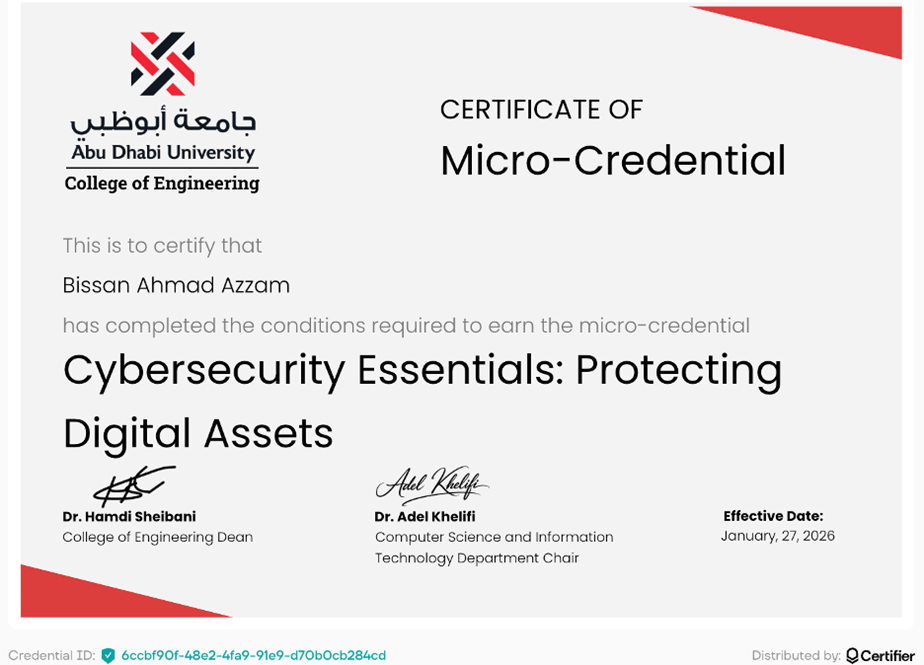
Example of the digital micro-credential as issued to learners.
What you'll see
- Credential title and issuing unit
- Recipient name and issuance date
- Verification link / QR
The actual credential is issued digitally via Certifier.io.
Overview
The Cybersecurity Essentials: Protecting Digital Assets Micro-Credential recognizes structured achievement in cybersecurity principles, network security, and information protection through a defined sequence of credit-bearing courses offered by the College of Engineering at Abu Dhabi University. The credential is designed to formally acknowledge learners who demonstrate competency in identifying, analyzing, and mitigating cybersecurity threats across modern computing and networked environments.
The pathway integrates three courses—CSE210 (Introduction to Cybersecurity Engineering), CSC305 (Data Communication and Networks), and ITE408 (Information Security)—that progressively develop foundational cybersecurity awareness, networking and communication knowledge, and advanced security implementation skills. Through this sequence, learners build capabilities in areas such as threat and vulnerability analysis, cryptographic methods, secure network communication, security policy and governance, and the design and implementation of technical security controls.
Unlike participation-based certificates, this micro-credential is awarded based on demonstrated academic achievement in assessed coursework and verified attainment of defined learner outcomes. The structure emphasizes hands-on laboratory activities, practical security analysis, network-level understanding of cyber threats, and the responsible implementation of cybersecurity practices.
The credential complements engineering and computing degree programs by recognizing a coherent set of cybersecurity competencies that are increasingly essential across technology-driven industries. It supports learners in strengthening their technical profile, demonstrating practical security skills to employers, and preparing for professional roles that involve protecting digital infrastructure, securing information systems, and managing cybersecurity risks.
Upon completion, recipients receive a digitally verifiable credential issued by Abu Dhabi University, enabling employers and institutions to confirm the achievement through an online verification page.
Standards & Rigor
Awarded based on demonstrated attainment through assessed, credit-bearing courses, not participation.
Accessible Pathway
Available to Abu Dhabi University students through the embedded course sequence, with an equivalency pathway for alumni or external learners through verified academic evidence.
Workforce Relevance
Emphasizes threat analysis, vulnerability assessment, secure system design, network-level defense mechanisms, and the responsible implementation of cybersecurity practices to protect digital assets and information systems.
Course Pathway
CSE210 — Introduction to Cybersecurity Engineering
Foundations of cybersecurity including the motivation for security, the value of personal and organizational data, threat actors, vulnerabilities, malware, and the real-world consequences of security breaches. The course introduces risk assessment, security management, and security control planning, together with cryptographic concepts such as hashing and public- and private-key encryption. Hands-on laboratory activities expose learners to intrusion detection, malware protection tools, database security (e.g., SQL injection), operating system hardening, and physical infrastructure security, while addressing legal and ethical considerations in cybersecurity.
Topics covered
- Threat actors and vulnerabilities
- Risk assessment and security controls
- Cryptography fundamentals
- Intrusion detection and system hardening
Prerequisite: ECT200 (Introduction to Computing)
CSC305 — Data Communication and Networks
Fundamental principles of data communication and networking required to understand how cyber threats propagate across networked systems. The course covers communication architectures, protocols, transmission techniques, multiplexing, switching, error detection and correction, and data link control. Laboratory activities explore wired and wireless networks, routing mechanisms, transport protocols, and logical addressing, while connecting network operation concepts with cybersecurity protection requirements.
Topics covered
- OSI and TCP/IP models
- Network protocols and routing
- Wireless communication technologies
- Network security and cryptography basics
Prerequisite: Junior Level
ITE408 — Information Security
Advanced application of information security mechanisms for protecting computing systems and digital assets. The course examines attack surfaces, security strategies, governance processes, security policies, and auditing practices. Learners implement cryptographic mechanisms including symmetric and asymmetric encryption, key exchange, authentication, and digital signatures. Laboratory activities address access control models, firewall configuration, intrusion prevention systems, malicious software analysis, and secure software development practices including protection against common vulnerabilities such as cross-site scripting.
Topics covered
- Cryptographic systems and key management
- Access control and authentication mechanisms
- Firewall configuration and intrusion prevention
- Secure software development and vulnerability protection
Prerequisite: CSC305 (Data Communication and Networks)
Pilot implementation:
During the pilot offering, learners who achieved a grade of B+ (85%) or higher in each of the three embedded courses were considered to have satisfied the academic requirements for the micro-credential. This pilot phase was used to validate the credential structure, confirm alignment with the defined learner outcomes, and gather performance and feedback data to support continuous improvement.
Credential Completion Conditions
Requirements to be awarded the micro-credential.
Primary Completion Requirements
All learners must satisfy both conditions.
Academic achievement: B+ (85%) or above in each of the three embedded courses.
Applied evidence: At least one of the following: technical/applied paper, substantial project or report, faculty reference letter, or verified experience letter aligned to the credential domain.
Alternative Completion Pathway (Equivalency)
For alumni or external learners not completing the embedded courses through standard enrollment, verified equivalent evidence may be considered through formal academic evaluation by qualified faculty designated by the College of Engineering.
Any equivalency determination is documented to ensure consistency and continued alignment with the credential’s learning outcomes and standards.
Faculty
Content creation and delivery are conducted by qualified faculty within the College of Engineering.
 Prof. Adel Khelifi, Ph.D.
Chair of the Computer Science and Information Technology Department; Professor of Computer Science
Expert in software engineering and information technology with extensive academic and professional experience across academia and international organizations. Senior IEEE member, ABET Program Evaluator, and contributor to open-source software initiatives in the region.
 Prof. Shehzad Ashraf Chaudhry, Ph.D
 Dr. Mohamed Elhadad, Ph.D.
.jpg?sfvrsn=5e9ad524_26) Dr. Moatsum Alawida, Ph.D.
Dr. Moatsum Alawida, Ph.D. Dr. Abid Mehmood, Ph.D.
 Dr. Modafar Ati, Ph.D.
 Dr. Deepa Shankar, Ph.D.
Contact Us
For more information about the credential please contact
Prof. Adel Khelifi, Ph.D.
Chair of the Computer Science and Information Technology Department; Professor of Computer Science
adel.khelifi@adu.ac.ae+97125015733
About the Micro-credential
The Cybersecurity Essentials: Protecting Digital Assets Micro-Credential recognizes structured achievement in cybersecurity principles, network security, and information protection through a defined sequence of credit-bearing courses offered by the College of Engineering at Abu Dhabi University. The credential is designed to formally acknowledge learners who demonstrate competency in identifying, analyzing, and mitigating cybersecurity threats across modern computing and networked environments.
The pathway integrates three courses—CSE210 (Introduction to Cybersecurity Engineering), CSC305 (Data Communication and Networks), and ITE408 (Information Security)—that progressively develop foundational cybersecurity awareness, networking and communication knowledge, and advanced security implementation skills. Through this sequence, learners build capabilities in areas such as threat and vulnerability analysis, cryptographic methods, secure network communication, security policy and governance, and the design and implementation of technical security controls.
Unlike participation-based certificates, this micro-credential is awarded based on demonstrated academic achievement in assessed coursework and verified attainment of defined learner outcomes. The structure emphasizes hands-on laboratory activities, practical security analysis, network-level understanding of cyber threats, and the responsible implementation of cybersecurity practices.
The credential complements engineering and computing degree programs by recognizing a coherent set of cybersecurity competencies that are increasingly essential across technology-driven industries. It supports learners in strengthening their technical profile, demonstrating practical security skills to employers, and preparing for professional roles that involve protecting digital infrastructure, securing information systems, and managing cybersecurity risks.
Upon completion, recipients receive a digitally verifiable credential issued by Abu Dhabi University, enabling employers and institutions to confirm the achievement through an online verification page.
Standards & Rigor
Awarded based on demonstrated attainment through assessed, credit-bearing courses, not participation.
Accessible Pathway
Available to Abu Dhabi University students through the embedded course sequence, with an equivalency pathway for alumni or external learners through verified academic evidence.
Workforce Relevance
Emphasizes threat analysis, vulnerability assessment, secure system design, network-level defense mechanisms, and the responsible implementation of cybersecurity practices to protect digital assets and information systems.
Three embedded courses form a vertically integrated sequence progressing from cybersecurity fundamentals and risk awareness, through networked system understanding, to advanced information security implementation.
CSE210 — Introduction to Cybersecurity Engineering
Foundations of cybersecurity including the motivation for security, the value of personal and organizational data, threat actors, vulnerabilities, malware, and the real-world consequences of security breaches. The course introduces risk assessment, security management, and security control planning, together with cryptographic concepts such as hashing and public- and private-key encryption. Hands-on laboratory activities expose learners to intrusion detection, malware protection tools, database security (e.g., SQL injection), operating system hardening, and physical infrastructure security, while addressing legal and ethical considerations in cybersecurity.
Topics covered
- Threat actors and vulnerabilities
- Risk assessment and security controls
- Cryptography fundamentals
- Intrusion detection and system hardening
Prerequisite: ECT200 (Introduction to Computing)
CSC305 — Data Communication and Networks
Fundamental principles of data communication and networking required to understand how cyber threats propagate across networked systems. The course covers communication architectures, protocols, transmission techniques, multiplexing, switching, error detection and correction, and data link control. Laboratory activities explore wired and wireless networks, routing mechanisms, transport protocols, and logical addressing, while connecting network operation concepts with cybersecurity protection requirements.
Topics covered
- OSI and TCP/IP models
- Network protocols and routing
- Wireless communication technologies
- Network security and cryptography basics
Prerequisite: Junior Level
ITE408 — Information Security
Advanced application of information security mechanisms for protecting computing systems and digital assets. The course examines attack surfaces, security strategies, governance processes, security policies, and auditing practices. Learners implement cryptographic mechanisms including symmetric and asymmetric encryption, key exchange, authentication, and digital signatures. Laboratory activities address access control models, firewall configuration, intrusion prevention systems, malicious software analysis, and secure software development practices including protection against common vulnerabilities such as cross-site scripting.
Topics covered
- Cryptographic systems and key management
- Access control and authentication mechanisms
- Firewall configuration and intrusion prevention
- Secure software development and vulnerability protection
Prerequisite: CSC305 (Data Communication and Networks)
Pilot Implementation:
During the pilot offering, learners who achieved a grade of B+ (85%) or higher in each of the three embedded courses were considered to have satisfied the academic requirements for the micro-credential. This pilot phase was used to validate the credential structure, confirm alignment with the defined learner outcomes, and gather performance and feedback data to support continuous improvement.
Learning Outcomes
Upon completion, learners demonstrate the following outcomes.
LO-1: Explain how cybersecurity principles and protection mechanisms are used to analyze security risks, safeguard digital assets across various application domains.
LO-2: Apply appropriate analytical and technical reasoning to develop and assess cybersecurity solutions, considering technical requirements, system vulnerabilities, threat landscapes, and contextual constraints.
LO-3: Evaluate the effectiveness, strengths, and limitations of cybersecurity controls and protection mechanisms, using evidence-based judgment to interpret results and inform improvement decisions.
LO-4: Integrate ethical and professional considerations into the design and implementation of cybersecurity solutions, recognizing their broader societal, economic, and legal implications .
LO-5: Communicate and collaborate effectively when addressing cybersecurity challenges, demonstrating responsibility, adaptability, and awareness of multidisciplinary perspectives.
Credential Educational Goals
CEG-1 — Professional Application
Enable learners to apply cybersecurity principles, methods, and tools to protect digital assets, secure networked and information systems, and mitigate cybersecurity risks in engineering, computing, and information technology contexts.
CEG-2 — Career and Workforce Relevance
Support learner readiness for current and emerging roles that require competence in cybersecurity engineering, network security, and information security, thereby enhancing employability, career progression, and effective participation in professional and organizational environments.
CEG-3 — Lifelong Learning and Adaptability
Prepare learners to engage in continuous professional development and to adapt to evolving cybersecurity threats, technologies, standards, regulations, and ethical considerations in rapidly changing digital and organizational contexts.
Credential Completion Conditions
Requirements to be awarded the micro-credential.
Primary Completion Requirements
All learners must satisfy both conditions.
Academic achievement: B+ (85%) or above in each of the three embedded courses.
Applied evidence: At least one of the following: technical/applied paper, substantial project or report, faculty reference letter, or verified experience letter aligned to the credential domain.
Alternative Completion Pathway (Equivalency)
For alumni or external learners not completing the embedded courses through standard enrollment, verified equivalent evidence may be considered through formal academic evaluation by qualified faculty designated by the College of Engineering.
Any equivalency determination is documented to ensure consistency and continued alignment with the credential’s learning outcomes and standards.
Content creation and delivery are conducted by qualified faculty within the College of Engineering.
Prof. Adel Khelifi, Ph.D.
Chair of the Computer Science
and Information Technology Department; Professor of Computer Science
Expert in software engineering and information technology with extensive academic and professional experience across academia and international organizations. Senior IEEE member, ABET Program Evaluator, and contributor to open-source software initiatives in the region.